

Remember when we all discovered ChatGPT and thought, “The future is here!” followed immediately by, “Is this coming for my job?”
I keep thinking about the awe I felt at what it could do, mixed with existential dread that the dark side of AI might be the end of us. I remember going down rabbit holes that confirmed my fears while simultaneously “training” my AI to think like me and write in my voice.
Then, we all convinced ourselves that AI can’t replace us because AI isn’t human, and us humans crave human connection.
I know that’s what I told my clients, my audience, and myself (and I actually still think that part is true).
We rationalized that AI can replace the mundane tasks, the things that drain energy but don’t require discernment or creativity.
I thought about Gay Hendricks’ work and how AI could free us up to be more in our “zone of genius,” to do higher-level thinking, deeper work, connect more offline, and essentially everything being a CEO asks of us.
I loved this for us.

Just like tractors freed people from working in the fields and gave us the Industrial Revolution. Just like computers, and then the internet, reshaped how we work and communicate and made way for the knowledge economy.
We talked about how things would evolve, but we’d adapt the way we always do with technology…because we’re entrepreneurs. We figure shit out. And we know we can’t fall behind on tech because we don’t want to be the Blockbusters of our generation.
But, we never really stopped to question whether AI was the internet, or the cigarettes, of our time.
So we did what we’re very good at doing: we pushed our fear aside.
And, then we got dazzled.
AI could spit out PDFs and social media posts for days. Outlines. Entire funnels. Almost-real-looking images with extra fingers. “Therapy” sessions. Coding and marriage advice.
We started telling our Chats and Claudes more than we told our spouses and besties, and it listened, validated us, and prompted us to tell it more.
You can still find my em-dash-filled emails from that time. I was proud of how well I’d “trained” ChatGPT in my business, voice, and thought process.
I always started with my original ideas and only used it as an editing tool, but it still reeked of leftover bot.
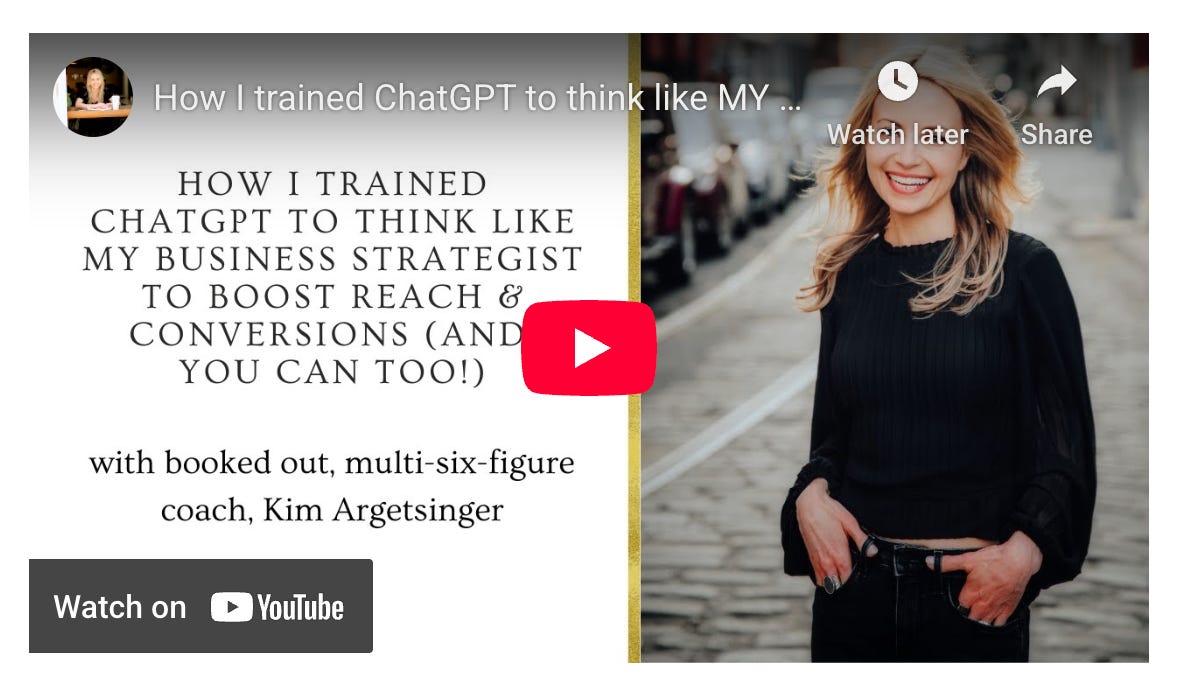
I went live to talk about How I trained ChatGPT to think like MY business strategist to boost reach & conversions (and, you can too!).
I used it to plan a trip to Iceland and build a shopping list for me, and it even helped me find my colors (I’m a “true autumn,” if you’re curious).
I hadn’t learned about the environmental impact yet, but I understood why we were worried it was coming for our jobs and trying to replace us.
Most of us were talking more to AI than each other. We were all starting to sound like it. And, the jokes about our kids dating AI started to feel a little less funny and a little more real.
At some point, I started noticing something else:
AI wasn’t coming for my job or trying to replace me or you.
It didn’t have to. Because we’re very willingly handing over more than our tasks; we were handing over our thinking, ideas, self-trust, and power in exchange for novelty, ease, speed, and entertainment.
I started to notice that the more I used AI, the longer it took me to create my own content. It looped me into overthinking and perfectionism with edits upon edits and suggestions.
A reel I used to be able to riff off in my own voice relatively quickly turned into an hour-long production of rewriting what ChatGPT “ruined” and tinkering to get it just right.
Suddenly a hook or email I would’ve previously trusted and posted as-is needed to be “checked,” “approved,” or made “better” by AI.
I also started seeing something slightly concerning through my 1:1 clients.
Not only was I getting reams of content to review that were clearly AI’s first draft (and SO NOT IT), but clients who used to be idea machines and loved creating started struggling when I prompted them to come up with their own thoughts.
More than a few times, I had to reflect to a client, “This sounds like ChatGPT wrote it,” or, “This really needs more work and needs to be fleshed out by you before I can review it.”
I even found myself having an “intervention” with a client who admitted to being “addicted” to AI.
This is when I really started to question things. It’s also when I decided to stop using AI for content creation outside of grammar edits and SEO keyword suggestions.
About this time, I flew to my coach’s retreat to spend the weekend with 22 other multi-six- and seven-figure business owners.
One of our mastermind table topics was AI and how we’re leveraging it in our businesses.

We shared smart integrations and thoughtful use cases like running retirement numbers and troubleshooting when ads were doing something funky and we needed help problem-solving tech.
But what stood out to me most wasn’t a new strategy or prompt. It was hearing almost every single one of us say we had stopped using AI for ideation or content creation.
As one of my seven-figure friends put it, her biggest AI content hack is not using it.
Our conversation shifted from how we leverage AI to how we can “quietly” spot AI content with its cadence and 🚀 emojis from a mile away.
We bitched about how it’s making everyone sound the same and ruining reach and trust, and how frustrating it is to be asked to review something clearly pumped through Chat or Claude.
More than one of us said that even using it to brainstorm or bounce ideas around felt like it made us worse, or at least took five times as long.
I laughed about how even some of the “rejection” or “hard conversation” emails I’ve received recently were clearly dropped into AI with the prompt to “sound nice and polite.”
But, this also isn’t just an AI thing.
For as long as I’ve been in business, people have looked for the secret in someone else’s business, templates, or strategy and modeled their marketing after whoever seemed to have figured out the “right” way to do content.
AI is just the newest place to outsource self-trust. But, we’ve been giving away our power as business owners long before it came on the scene. It’s just speeding up the process.
When I read a sales email that so clearly sounds like it was written by someone else, my reaction isn’t, “Wow, I can’t wait to sign up for their class or mastermind!”
I’m also not mad, and I don’t feel like, “Gotcha!”
But, I can no longer hear anything that was said, and I definitely don’t hear the person writing to me.
When I get a post in my feed with helpful, but generic, information or a copy-and-paste DM, I’m not impressed by the em-dashes or how clever it sounds. I don’t want to ask follow-up questions.
I just think, if I want to hear what ChatGPT has to tell me, I have a paid account, and I’m better off asking it so I can get a more personal response and attention.
Which might sound like this is just me hating on AI or suggesting it’s “cheating” to use it.
Not at all. I think most of us are using it at this point to some degree. I’m here for scaling smarter, not harder. And, business owners have been using copywriters and ghostwriters for forever.
But when we’re in a trust recession, the online space is more saturated than ever, and as we talked about last week, people are craving transparency and want to know you are who you say you are.
That becomes a real problem when your thoughts and voice are created by or filtered through a bot.
AI isn’t coming for our jobs. We’re happily handing them over one interaction at a time.
That might not be surprising. But, what I didn’t expect was the darker side of AI use - the “addiction” my client mentioned, and noticing how it’s weakening our critical thinking skills, discernment, ability to ideate, and self-trust.
The more we give our power away to AI, just like when we give our power away to anything or anyone, the more replaceable we become. And, the more we’re asking something else to replace us and think for us.
This isn’t me fear mongering. There’s emerging research showing a heavy reliance on AI for things like writing, problem-solving, or reasoning (basically anything that’s a cognitive or critical thinking function) is fucking us up.
Not to get overly nerdy, but over-reliance on AI is linked to lower brainwave activity and weaker brain connectivity (MIT), “cognitive debt” (poor memory and retention), and even changes in brain structure.
Interestingly, there’s also research suggesting that moderate use of technology can help preserve cognitive function as we age.
Studies aside, this all makes practical sense.
Remember when you could tell which coach everyone was working with because their content started to sound exactly like them, down to word choice?
That’s what AI is doing. Except now it’s not a handful of people using the same template. It’s everyone who’s plugged in.
And have you ever noticed what happens in a group setting, like a mastermind, when someone asks for feedback or to brainstorm? As soon as the first person speaks, it’s almost impossible not to follow suit and say something similar.
Unless you write down your original thoughts before anyone speaks, it’s incredibly hard to access something truly your own or outside what’s already been introduced.
That’s how groupthink works. And, that narrowing of possibility is similar to what happens when you brainstorm with AI.
The moment it spits out an idea or suggestion, the range of thoughts your brain can access shrinks.
Back to AI “coming for our jobs.”
I used to think AI wasn’t a threat because I saw it as a tool. And when it’s used that way, I still believe there are useful applications that will only expand.
But, when I see how we’re using AI as a substance, with very real, dopamine-producing, addictive qualities that ask us to give up more and more of ourselves and our ability to think to get that next hit…
It’s clear AI isn’t coming for anything. We’re handing it over along with our power.
Which made me wonder: did Blockbuster really go bust because it failed to evolve with technology, or was there something else at play?
Yes, Blockbuster missed innovation.
But there’s also evidence pointing to failed leadership, poor decision-making, cognitive bias, a lack of clarity around their value proposition, and an erosion of trust in strategies that were working…all of which contributed to bankruptcy.
I’m not suggesting that self-trust, critical thinking, and discernment are the only skills that matter as a CEO in an AI-driven world. But, they’re at the very top of the list, and they’ve always been there.
I’m also not suggesting AI is bad or that we should swing the pendulum back to going fully analog.
AI isn’t good or bad. It’s neutral. The same way cocaine isn’t good or bad. It just is.
But, how you use both matters. Both are highly addictive when used as substances. And, both affect your ability to think clearly and trust yourself.
AI isn’t replacing us in the ways we were worried about.
We’re making ourselves replaceable one prompt at a time.
Because at the end of the day, business is built on social currency and strategic relationships. Humans crave connection. We buy from people we know, like, and trust.
But when we outsource who we are to a bot, it gets better at sounding human than us. And when we give it our trust and our thinking, it becomes the more “personal” option.
More than anything, our brains, and our ability to think for ourselves, are what make us human. This is our greatest asset alongside our humanness.
I don’t have all the answers. I know AI will continue to evolve faster than we can keep up with and reshape business in ways we can’t even imagine.
I have no intention of burying my head in the sand. I’m interested in using AI as a tool for efficiency and discoverability as more people turn to it for their search options.
But my priority, and what I know keeps me irreplaceable to my high level 1:1 clients and sustains my business, is trusting myself and strengthening my critical thinking, creative thinking, discernment, and problem-solving skills.

For me, that means creating white space and CEO time for deep work and original ideation and content creation before ever asking AI for edits (if I ask at all).
It means I’m being intentional with when and how I choose to use AI, and when I don’t. And, when I do, I’m using it as a tool and not a substance or thought partner.
And more than anything, it means remembering what I’ve always known to be true: business is about people, relationships, and bringing humanity to the humans we serve.
AI can’t replace that, unless we let it by giving up the very things that make us human in the first place.
Because the threat isn’t AI. It’s outsourcing our thinking, authority, power, and personalization to anything outside ourselves, and that erosion shows up in trust, originality, sales, retention, and scalability.
Kim Argetsinger is a NYC-based high level 1:1 business coach and mentor. She writes about business, success, and money from the inside out.
Learn more at kimargetsinger.com.